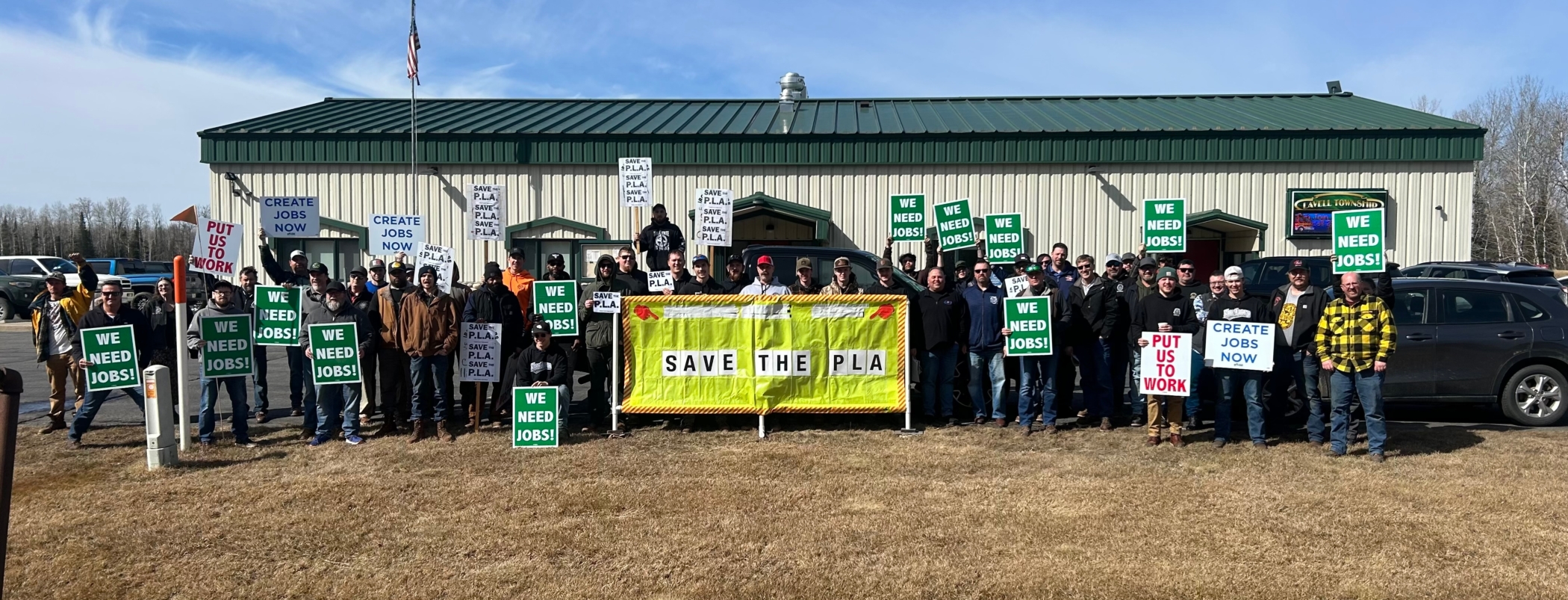
Five road projects in St. Louis County have turned into a faceoff between the federal government and the county itself.
The Department of Transportation has millions of dollars ready to go for the county to use on roads and bridges projects, but it comes with a catch: That the county drop its Project Labor Agreement requirements on bidding.
And at the St. Louis County board meeting in Hibbing on March 24, county commissioners signaled that a fight is brewing.
The requirement about dropping PLAs appears to have come from a series of emails from former TV reality star Sean Duffy, now secretary of the Department of Transportation, and his office, as well as the U.S. attorney’s office.
All St. Louis County projects require a PLA unless it’s prohibited by law. According to Jim Foldesi, director of public works for St. Louis County, the usual process required the county to get permission for PLAs on federal projects by writing a justification letter to the Federal Highway Administration (FHWA) that has in the past been routinely approved.
“This time around…we haven’t gotten any clarifying responses, we just haven’t got an answer,” Foldesi told the board. The county has received an email from the federal government saying that if the county decides to move forward with PLAs without FHWA approval, the project will not be available for federal funds.
The county was an early adopter in these kinds of agreements, requiring prevailing wage language for projects since 1973 and approving PLA requirements in 2004. At the time, an executive order from then-President George W. Bush prohibited PLAs on federal projects, and St. Louis County followed the order. President Barack Obama rescinding the prohibition and in 2014 St. Louis County implemented its requirement at that time.
But now, “legally, we’re in no man’s land,” Foldesi told the board. “Our purchasing rules require us to put PLAs on these projects unless the board exempts them from the policy. That’s why we have to come to the board at this time, to ask for these five projects to be exempted from the policy.”
At stake is $7.7 million in federal funds for $14 million in projects. The projects include work on 40th Ave. West in Duluth, Highway 21 in Pike Lake and Embarrass Township, Canosia Road outside of Duluth, among others.
Foldesi warned that refusing these funds by not dropping PLAs could jeopardize the county’s strong reputation as a “dependable partner” for the federal government. “We have never turned back funds or failed to deliver, and we will not be able to check that box anymore. It hurts our ability to go after federal funds,” he said.
In addition, it could jeopardize requests at the state level, Foldesi said. “It’s hard to ask for money when we’re turning back money.”
Foldesi said because of the strength of local contractors and their ability to control materials, he expected bids to still go to them even without PLA requirements. “Contractors and trades can also still sign PLAs; we just can’t require it.”
As a result, the public works administration is requesting the county to exempt the five projects receiving federal funds.
Members of the Building Trades attended meeting to tell commissioners to hold strong.
Dropping the PLA requirement “opens us up for a race to the bottom,” said Jack Carlson, president of the Duluth Construction and Building Trades Council. “We don’t know what will happen 5, 10, 15 years down the road with this administration, let alone tomorrow.”
“PLAs have been used for years because they work,” said Kyle Bukovich, president of the Northern Wisconsin Building Trades Council. “We’re talking here about making a permanent decision under short-term pressure. Two years from now, we won’t be talking about how smart this decision was; we’ll be talking about how to fix what was undone.”
Jeremy Lambert, an organizer with Iron Workers Local 512, said that as a resident of Wisconsin who works across the northland, he knows what not having the protections of a PLA is like. “[St. Louis County] is one of the strongest Labor areas in the whole United States, and you have to think about local people as you make these decisions,” he said.
Commissioners acknowledged the conundrum and have delayed a vote until April 7, hoping to find a solution in the meantime. In addition, they questioned why U.S. Congressman Pete Stauber (MN08-R) has done so little to help.
Stauber provided a comment to the Duluth Monitor about the issue in March: “Project Labor Agreements are our way of life in Northern Minnesota and an established standard for projects in the region. It would be foolish for St. Louis County Commissioners to walk away from millions of federal highway dollars that will improve the lives of our shared constituencies.”
“Why isn’t he doing anything in his power to do something about this?” said Annie Harala, 1st District commissioner. “He can’t take time to stand with workers here? I encourage everyone to reach out to Stauber to get something done…Our families are not a bargaining chip.”
Keith Musolf, 5th District commissioner and member of Iron Workers Local 512, said the federal government is union-busting. “This is a Labor strong-wall in the U.S. and that’s exactly why it’s being tested. If we waver now, we have nothing to stand on,” Musolf said. “I don’t believe we should be doing this to the men and women working in St. Louis County. Why are they on the menu? That’s a bunch of crap.”
Patrick Boyle, 2nd District commissioner, brought up the federally mandated changes to DEI policies that arose last year, and Jim Gottschald, director of human resources for St. Louis County, said it was a similar issue, as the federal government used federal dollars as pressure on administrations to make the changes, but those changes came with a cost nonetheless.
“Not only employees but our community partners came to our board meetings and were critical of the actions to step back,” Gottschald said. “The justification was we were not in a position to jeopardize funds, and there was an additional liability for those who signed agreements under the False Claims Act. It was deemed to be too high of a risk for the county to continue its practice in this space. We made some pretty significant changes and we still live with the fallout of those.”
Ashley Grimm, 3rd District commissioner, said solidarity was needed more than ever. “There’s no good solution because when the federal government plays hardball and you resist, it hurts. But we also have to hold some kind of line.”
Mike Jugovich, 7th District commissioner and chair of the board, invoked his background as a Steelworker in his comments. “I completely agree with Commissioner Musolf, this is union busting 101 and I don’t bust unions; I build them. I’m a Steelworker and I’ll be one until I die — and maybe I’ll haunt some of you,” he said to laughter.
“If this wasn’t union busting, there never would have been language around PLAs. If we don’t stand up tot his, it’s the top of the spear, and the tip will drive in and wit will break. I cannot look people in the eye and say I support unions and PLAs until 1600 Pennsylvania Avenue says I can’t. We don’t want to lose that money but I don’t want to lose my soul along the way.”